
——- INSIGHTS / BRAZIL & COMMERCIAL EXECUTION
The meeting went well. Nothing happened.
Why promising meetings and good technology don't always translate into business in Brazil.
By Stian Soltvedt | Founder & Managing Director, Norealis Energy
Oct 9th, 2026

The meeting was excellent.
The technology addressed a genuine operational challenge. The customer asked the right questions, recognised the potential and expressed interest in exploring it further.
Handshakes all around.
Back at headquarters, the visit was reported as a success. Management was encouraged. Brazil looked promising.
Three months later, a few more meetings had taken place. Some useful contacts had been established. There were encouraging emails and invitations to follow up.
Six months later?
Still no trial. No purchase order. No contract.
Just a growing list of contacts, presentations and opportunities that never quite became opportunities.
Sound familiar?
The uncomfortable difference between interest and opportunity
Brazil offers substantial opportunities for energy technology companies.
Large offshore developments, complex operational challenges and technically capable operators create genuine demand for innovation, efficiency and improved performance.
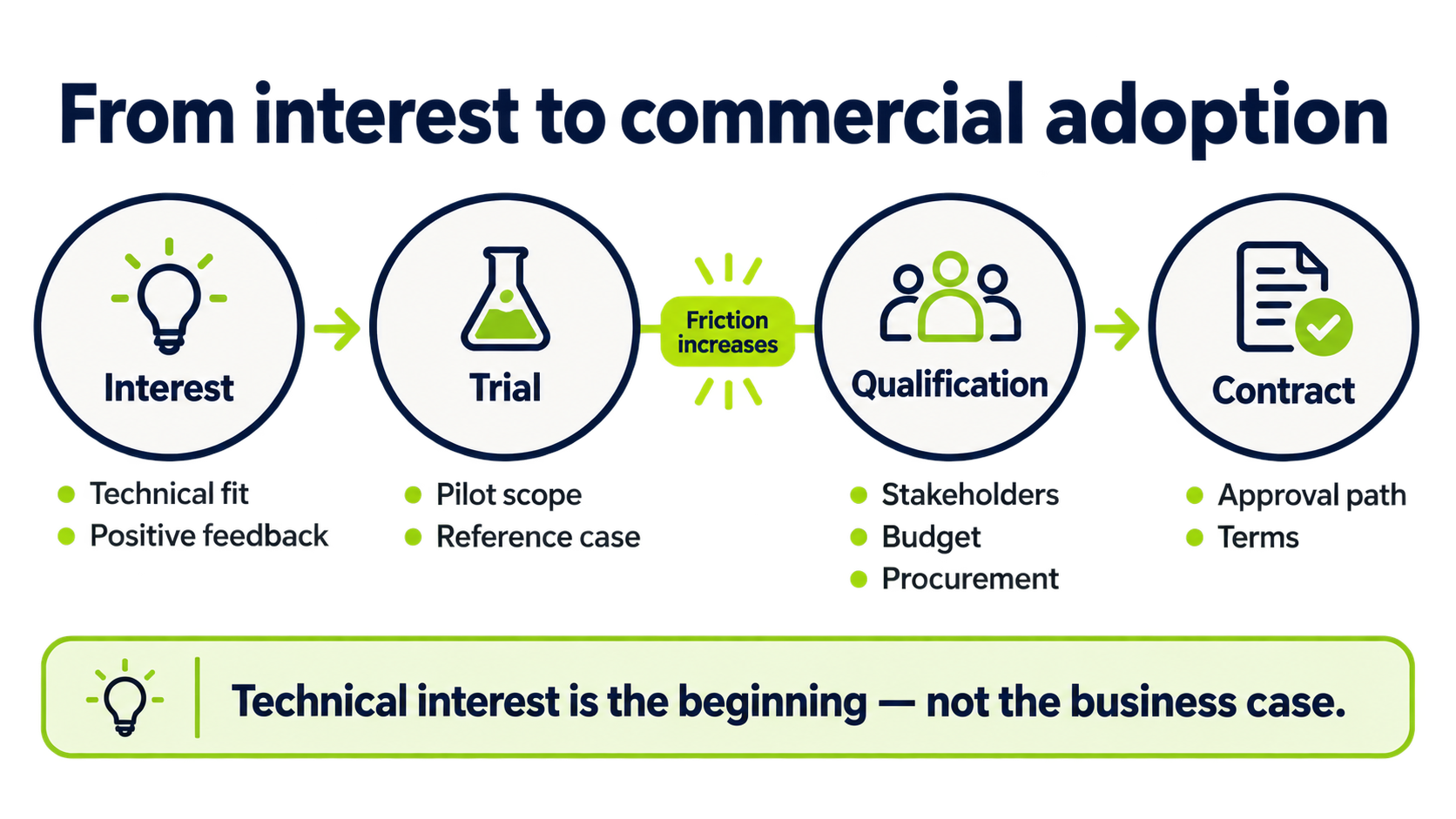
But technical interest is not the same as commercial demand.
A customer may appreciate the technology, recognise its potential and genuinely want to see it implemented.
That doesn't mean the organisation is ready, willing or able to buy it.
Between technical interest and commercial adoption sits a series of decisions, requirements and responsibilities that are often poorly understood by companies entering a new market.
The technology might be excellent.
The business opportunity might not yet exist.
And understanding that difference early can save considerable time and money.
Everyone likes the technology.
Nobody owns the next step.
This is where many promising discussions lose momentum.
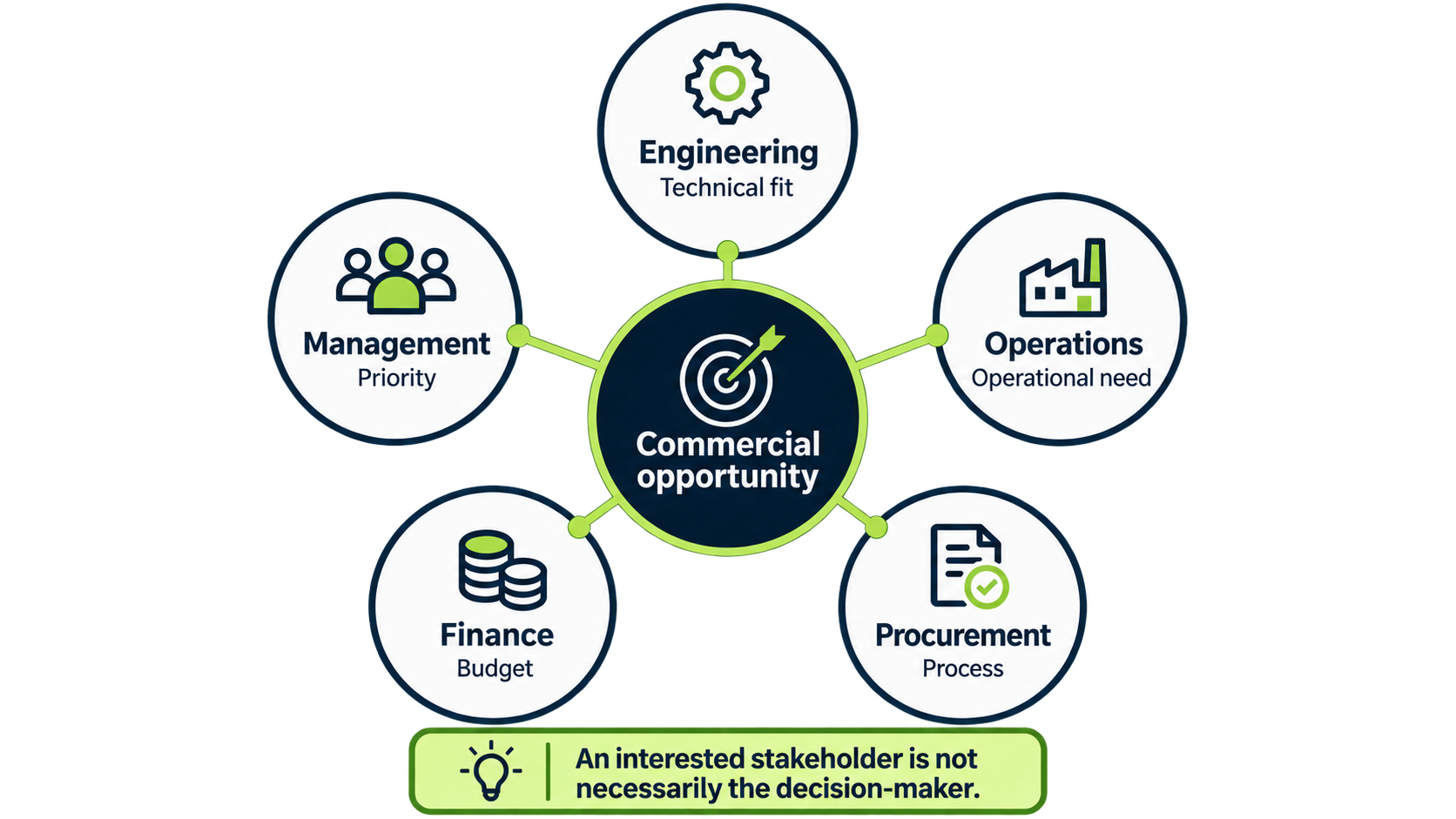
Engineering sees the technical benefit. Operations recognises a potential application. Management supports innovation.
But who is actually responsible for moving the opportunity forward?
Who owns the operational problem? Who has authority to sponsor a trial? Who controls the budget?
What technical qualification or supplier registration is required? How will the technology be contracted, implemented and supported?
And who inside the customer organisation is prepared to take responsibility for making it happen?
These are not necessarily questions for the same person or department.
In a large energy company, technical evaluation, operational priorities, procurement, finance and management approval can involve several stakeholders with different objectives and decision-making authority.
Understanding these relationships is as important as understanding the technology itself.
An interested stakeholder is not necessarily a decision-maker. And a decision-maker is not necessarily the person who needs the solution.
A successful commercial approach must connect the two.
The Brazilian market is not necessarily the problem
When opportunities stall, explanations often point towards bureaucracy, complicated procurement processes or slow decision-making.
Sometimes those are genuine constraints.
But not every stalled opportunity is a Brazil problem.
Sometimes the operational need hasn't been properly validated. Sometimes the economic case doesn't justify the change. Sometimes the wrong stakeholders are involved.
Sometimes the technology is being promoted before the route to qualification, contracting or implementation is understood. And sometimes there simply isn't a sufficiently strong reason for the customer to act.
These are commercial execution challenges, not necessarily market barriers.
Brazil has its own regulatory, contractual and business environment. Foreign companies need to understand and navigate it. But local knowledge alone won't turn an interesting technology into a purchase order.
The commercial approach must be built around how the customer actually identifies, evaluates, approves and adopts new solutions.
That requires more than access to a contact list.
More meetings are not always the answer
When progress slows, the usual response is to increase activity.
More introductions. More presentations. More conferences. More follow-up emails. Perhaps another trip to Rio.
All of these can have value. But activity is not the same as progress.
Ten meetings with interested stakeholders can achieve less than one productive discussion with someone who owns a genuine operational problem and can help establish a route towards solving it.
The objective isn't simply to convince the customer that the technology works. It's to establish whether a viable business opportunity exists, and what it takes to develop it.
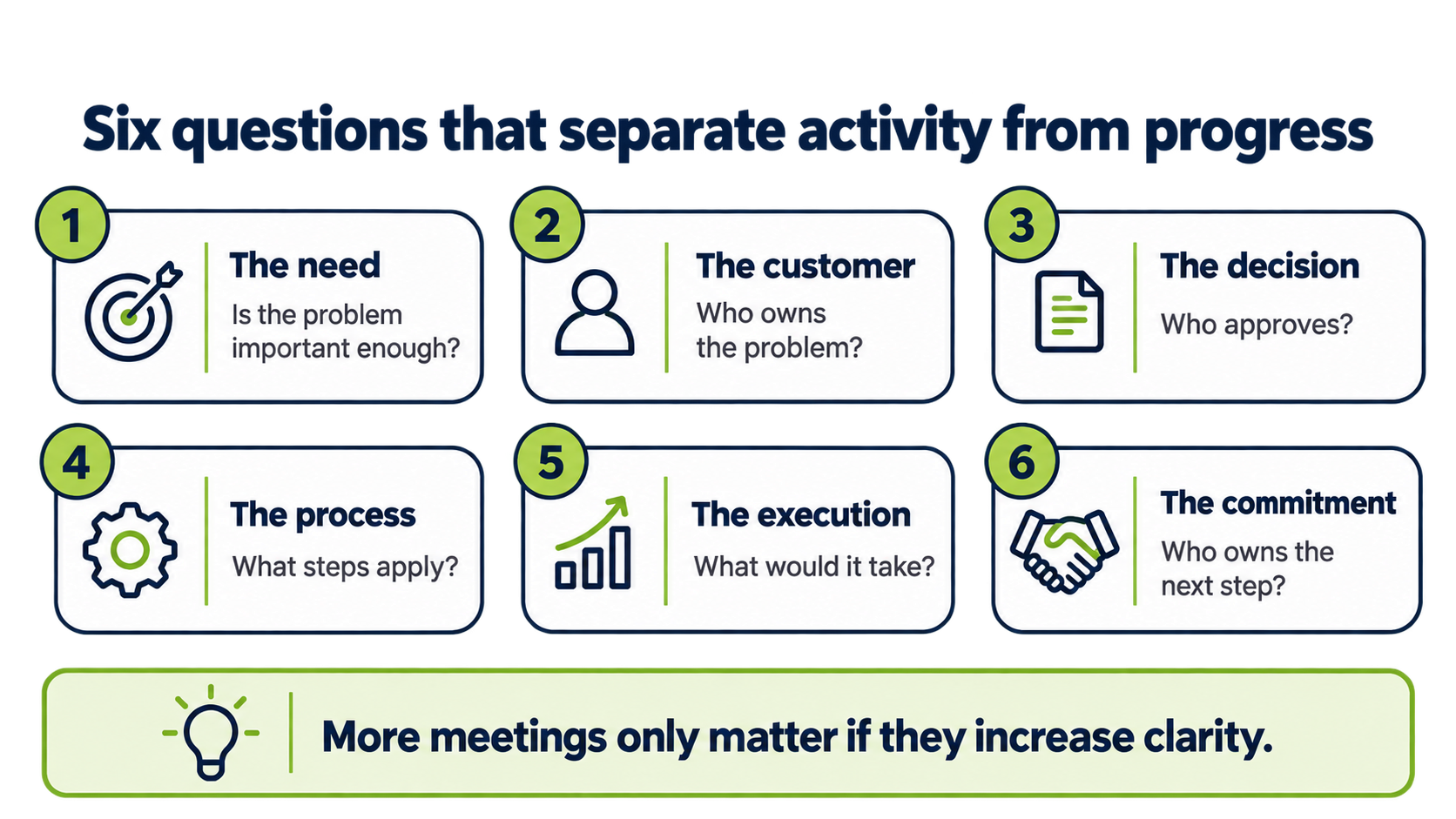
Before investing months in commercial follow-up, a few fundamental questions deserve clear answers:
The need: Is there a specific operational problem with sufficient technical or economic importance?
The customer: Who owns that problem, and who benefits from solving it?
The decision: Who evaluates the technology, influences adoption and approves the expenditure?
The process: What qualification, procurement, contracting or regulatory requirements apply?
The execution: What would a realistic trial, first deployment or implementation require?
The commitment: Who will take ownership of the next step, and when?
Not every answer needs to be available after the first meeting. But each meaningful interaction should reduce uncertainty and move the opportunity towards a decision.
If six months of meetings haven't clarified the path forward, the issue may not be the number of meetings.
The real work begins after the handshake
Relationships matter. Trust, credibility and access can be decisive when introducing new technology into an established operating environment.
But relationships should enable commercial execution, not replace it.
Effective local representation or business development goes well beyond arranging introductions and maintaining contacts.
It requires understanding the customer's organisation, identifying genuine operational needs, connecting technical stakeholders with commercial decision-makers and addressing the practical obstacles to adoption.
It also requires discipline in deciding which opportunities deserve attention.
Sometimes the right approach is to accelerate the engagement. Sometimes it's to change the commercial strategy, identify a different application or involve other stakeholders.
And sometimes the most valuable advice is the least exciting:
The customer likes the technology, but there isn't a sufficiently compelling business case to pursue it right now.
That's not necessarily a failure. Recognising a weak opportunity early allows resources to be redirected towards stronger ones.
Time, technical support and management attention are limited. They should be invested where there is a credible path to commercial results.
So, was the meeting successful?
A good meeting does not need to end with a commitment to buy. It may clarify a genuine need, identify a workable first application or bring the person who owns the problem into the conversation. Those are meaningful steps, even when a contract is still some way off.
The encouraging sign is when someone inside the customer’s organisation starts seeing the opportunity as a way to achieve something that matters to them. An engineer wants to improve reliability. An operations manager sees a chance to resolve a recurring problem. A budget owner can see a return worth pursuing.
Now there is a reason for the conversation to continue beyond the fact that the supplier would quite like it to.
That ownership can take time to develop. Where it is not yet clear, understanding who would benefit most, and what would motivate them to act is a useful objective for the next conversation.
So, alongside “How did the meeting go?”, there is another question worth taking back to headquarters:
If we stopped following up, who at the customer would ask what happened, and why?
About Norealis Energy
Norealis Energy helps international energy and technology companies enter, develop and grow in Brazil by connecting market understanding, commercial strategy, local relationships and practical execution
Helping energy companies succeed in Brazil.